A cabinet of oddities
Strange, surprising and little-known hen stories
An official zero for an empty hen house, egg rationing that lasted until 1953, a 1938 “maternity ward for hens,” a paraffin incubator, and a Lion that was dropped and then came back. Each of these has been checked against a government release, a museum, an official history, or a library catalogue. Legends are labelled, and this cabinet does not invent what the sources do not say.
An empty shed, counted as zero
Official wording from the England poultry survey.
73% and 72%
Two official percentages, two different totals.
A maternity ward for hens, 1938
A Library of Congress caption that still startles.
Egg rationing until 1953
The war had ended. The vouchers had not.
The Little Lion, dropped, then returned
A trademark with a disappearing act.
Go to Work on an Egg
Tony Hancock, and a 14 per cent rise.
A paraffin incubator, about 1930
The Science Museum Group’s Hearson Junior 600.
Red-tinted lenses for hens
A 1963 press collage, carefully captioned.
Ultra violet light, and a cage ban
A Defra idea from December 2011.
The cockerel that lived without a head
Fruita, 1945, as a BBC feature tells it.
The Chicken of Tomorrow
A USDA library record of a national contest.
A tin of Poultry Spice
A chemist’s promise, in a museum catalogue.
If the hen house is empty on 1 June, the official figure can be zero
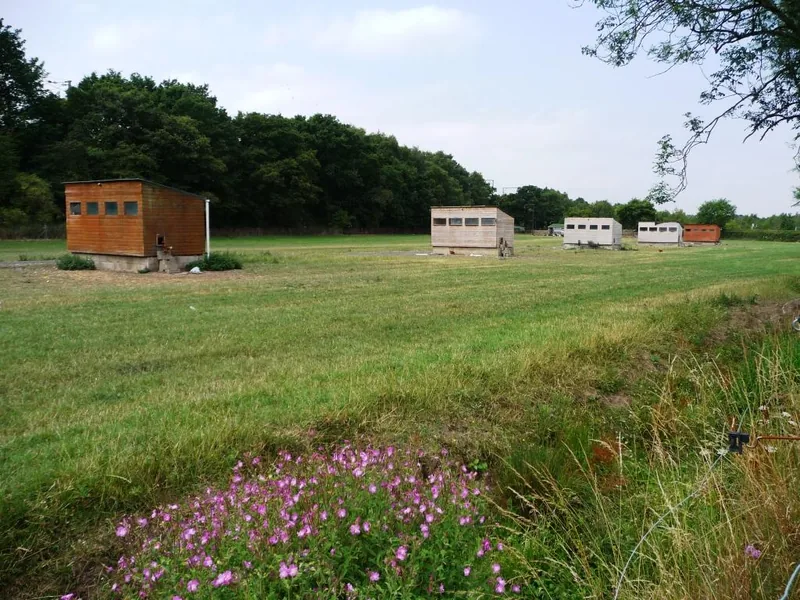
The England livestock release explains that “the structure of the industry means that sheds must be empty between crops of poultry for cleaning and to prepare for the next crop.” If the poultry shed is empty on 1 June, “we ask the respondent to specify ‘0 animals’ and tick a box that confirms that this is because the shed is temporarily empty.” [source]
It is one of the least expected official sentences in British poultry: a farm can still be there, the sheds can still be there, and the official number, on that morning, is zero.
73% of one official total, 72% of another
The same England release says hens and pullets laying eggs for eating “account for 73% of the total breeding and laying fowl,” and that table chickens (broilers) “account for 72% of all poultry.” [source] The percentages look like twins. They are not. One is a share of the breeding and laying birds. The other is a share of every bird in the poultry count, of which table chickens are, officially, the majority — 95.3 million, against 30.5 million breeding and laying fowl, in a poultry total that “remains at 133.0 million.”
A “maternity ward for hens,” 9 August 1938
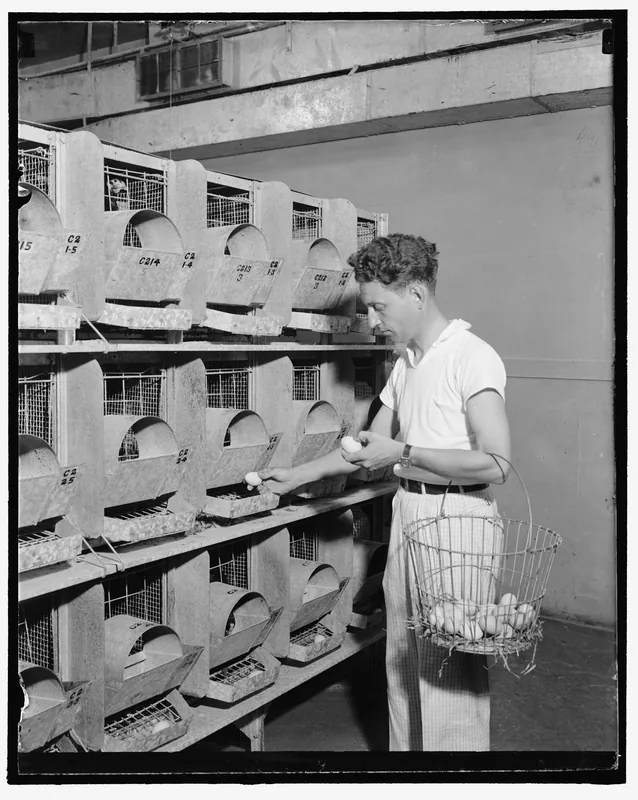
A Harris & Ewing photograph in the Library of Congress is dated 9 August 1938. Its official caption begins, “Air conditioned hen house is latest,” and then goes further: “The first temperature controlled maternity ward for hens has just been put into operation at the governmental experimental farm here.” R.B. Nestler, “poultry expert,” is “pictured as he removes the eggs from the automatic chute in the new room.” “Note the air conditioning apparatus on the ceiling.” The hens, the caption claims, had “voiced their approval by laying more frequently; also a more uniform egg.” [source]
This site presents that wording as a 1938 American caption, not as a modern paper, and not as a Defra result. The surprise is the official language itself: a maternity ward, an automatic chute, and an approval the hens are said to have voiced.
Egg rationing lasted until 1953
The British Egg Industry Council’s official history says that during the Second World War eggs were rationed, and consumers were given vouchers. The National Egg Distributors’ Association Limited (NEDAL) was set up to supply eggs. Then: “As the war progressed, a shortage of animal feed meant that the number of hens declined, forcing egg rationing to remain in place until 1953.” [source] Eight years after the end of the war in Europe, the official history of the British egg still has a shortage of hens, caused by a shortage of feed.
The Little Lion was dropped, then came back
Under the British Egg Marketing Board, the official history says, first-quality eggs had to be stamped with their grade and with a number that could locate the packing station. “To this, the BEMB added its own trademark — a Lion.” “The ‘Little Lion’ became a well-known symbol.” [source] The Government “removed the requirement to stamp eggs in 1968.” When the Board was replaced by the Eggs Authority in 1971, “the Lion symbol was also dropped at this time.” [source]
In 1998, the history records, the British Lion Code of Practice was launched, requiring compulsory Salmonella vaccination for the first time. In 2000 the Council “reintroduces the Lion Quality mark including best before date onto shells of all Lion eggs.” [source] A trademark, officially, can vanish from the box and later be printed on the shell itself.
“Go to Work on an Egg”
The same official history says the advertising slogan “Go to Work on an Egg” was introduced “and featured on TV ads with comedian Tony Hancock.” “The slogan developed into one of the most popular and memorable advertising campaigns of all time.” Advertising and other Board activities “saw egg consumption increase by about 14 per cent between 1957 and 1970.” [source] Later Eggs Authority slogans, after 1971, included “Crack a Meal Today,” “Thank Goodness For Eggs,” “Go Smash an Egg” and “The Egg Lover.” [source]
A paraffin-heated incubator, about 1930
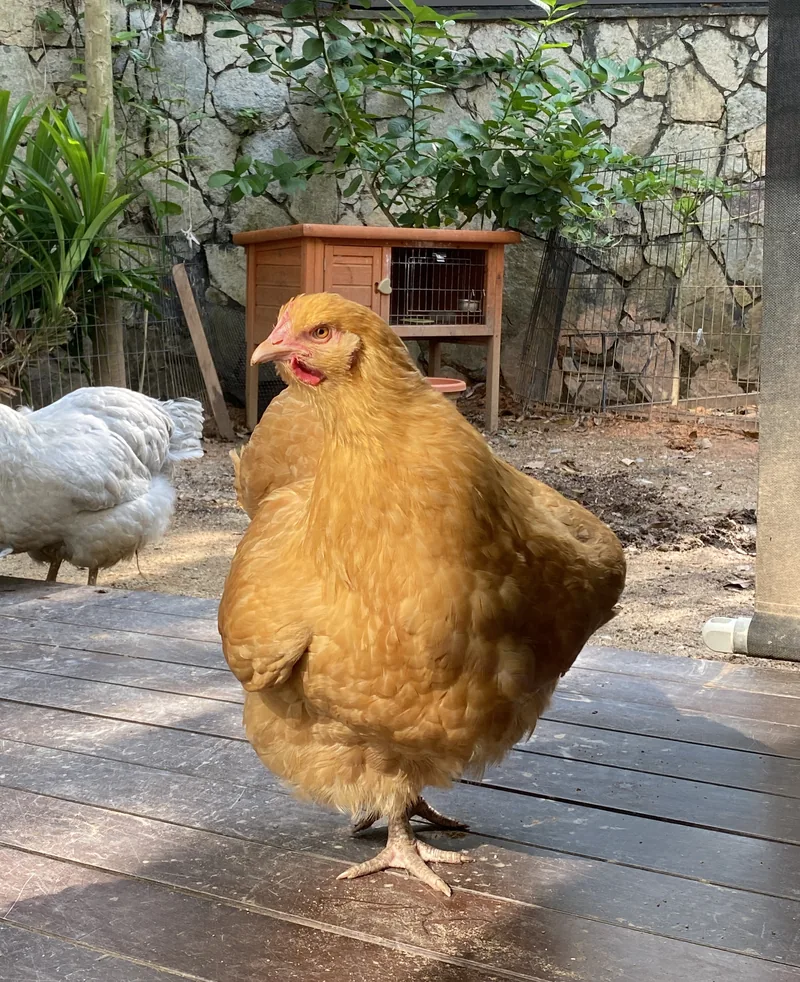
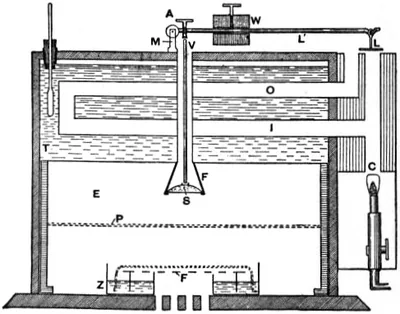
The Science Museum Group holds an egg incubator, the “Junior 600” by Hearsons, dated about 1930: “water circulation, paraffin heated.” [source] It also holds an incubator by Hebditch, about 1930: “convection circulated air, paraffin heated.” [source] Before electric cabinets became ordinary, the official museum labels still smell of lamp oil. The 1911 encyclopaedia diagram on this page is an earlier Hearson illustration, not a photograph of the museum’s Junior 600, and is captioned as such.
Red-tinted contact lenses, in a 1963 press collage
The Science Museum Group holds a Daily Herald collage, dated October 1963: a photograph of a chicken overlaid with illustrated spectacles. The museum catalogue says a published article attached to the back “explains how veterinary surgeon, Dr. William Blount, described the use red tinted contact lenses to reduce fighting and increase egg production at poultry farms.” [source]
This site uses that catalogue wording, and does not claim that the lenses became standard, or that the newspaper had proved the results. It is a press object in a museum, and it is strange enough, left as that.
Ultra violet light, and the end of the battery cage
A Defra press release of 6 December 2011, “UK unites to stamp out battery cages,” said that an EU ban on battery cages would come into effect on 1 January 2012. Producers would have to provide “larger and more comfortable cages, which include nesting and scratching areas.” And then the official peculiarity: the Animal Health and Veterinary Laboratories Agency would “use ultra violet light to identify batches of eggs that were not laid in the new, more welfare friendly cages.” [source] Council Directive 1999/74/EC remains on legislation.gov.uk. [source]
The cockerel that lived without a head
On 10 September 1945, in Fruita, Colorado, a bird later called Mike lived on after Lloyd Olsen’s hatchet. A BBC News Magazine feature of 10 September 2015 tells the family account, credits a Life magazine photograph, and records that Mike died in Phoenix in the spring of 1947, after 18 months. [source] The full telling, with what this site does and does not take from that feature, is on its own page.
A contest to breed the Chicken of Tomorrow
The USDA National Agricultural Library holds the Robert Morris Smith Papers of the American Poultry Historical Society. The official collection description says the papers contain “letters and other documents leading to the establishment of the National Chicken-of-Tomorrow Program, 1945–51,” including “Correspondence leading to the establishment of the Chicken-of-Tomorrow Program and its first National Committee, 1945,” “Rules Governing the State, Regional and National C.O.T. Contests, 1946–51,” and “Original performance records of the National C.O.T. Contest, 1951.” [source]
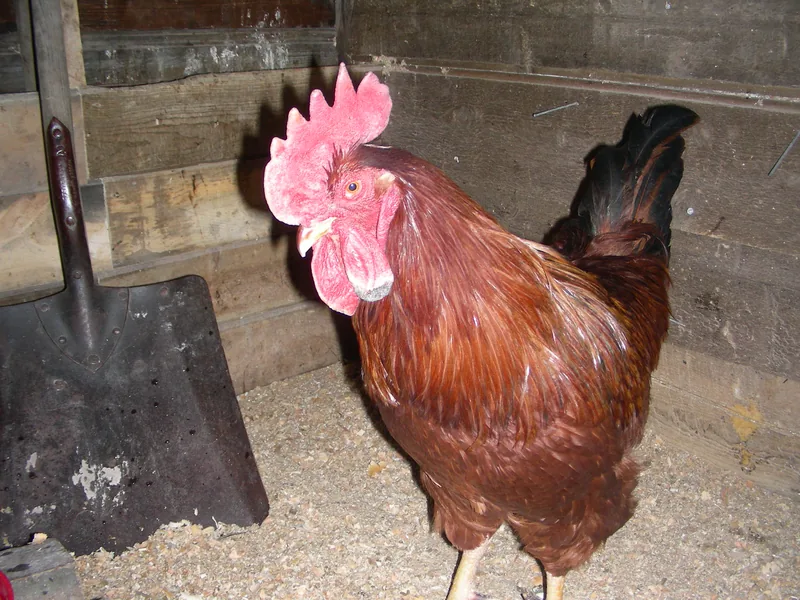
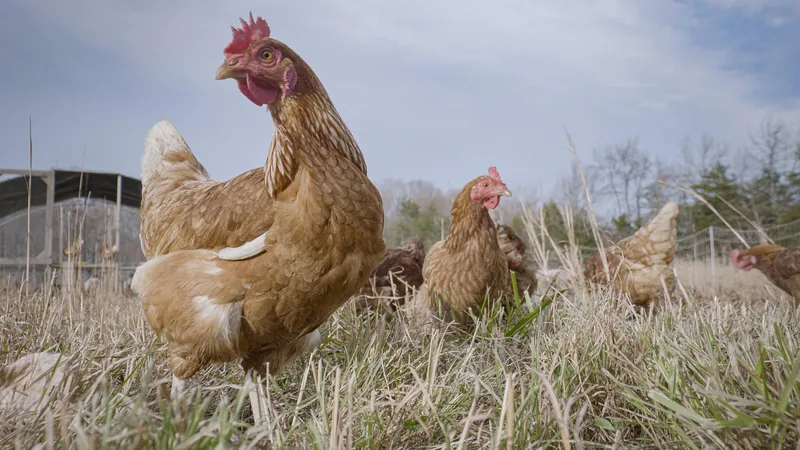
“The thrust of the Chicken-of-Tomorrow contest,” the same official description says, “was to encourage meat-type poultry breeders to develop a better, more efficient broiler.” [source] This site uses that library wording, and does not add later popular accounts of particular winners. The pasture-raised hens in the USDA photograph beside this story are a later American picture, not a portrait of the contest itself, and are captioned as such.
A tin that promised more eggs
The Science Museum Group holds a “Tin of Poultry Spice for increasing egg supply and keeping chickens healthy,” supplied by Trevithick (Chemists), Kidderminster, 1920–1940. [source] The promise is in the object’s official name. This site does not treat a chemist’s tin as a proof that the spice worked. It is a reminder that people have long wanted a simple way to make a hen lay more, and that a museum will keep the tin.
Enjoyed the henhouse?
No pop-ups. No intrusive advertising. Just interesting stuff. A little support helps the next farmyard site get built.